

 EN

 CN
 ES

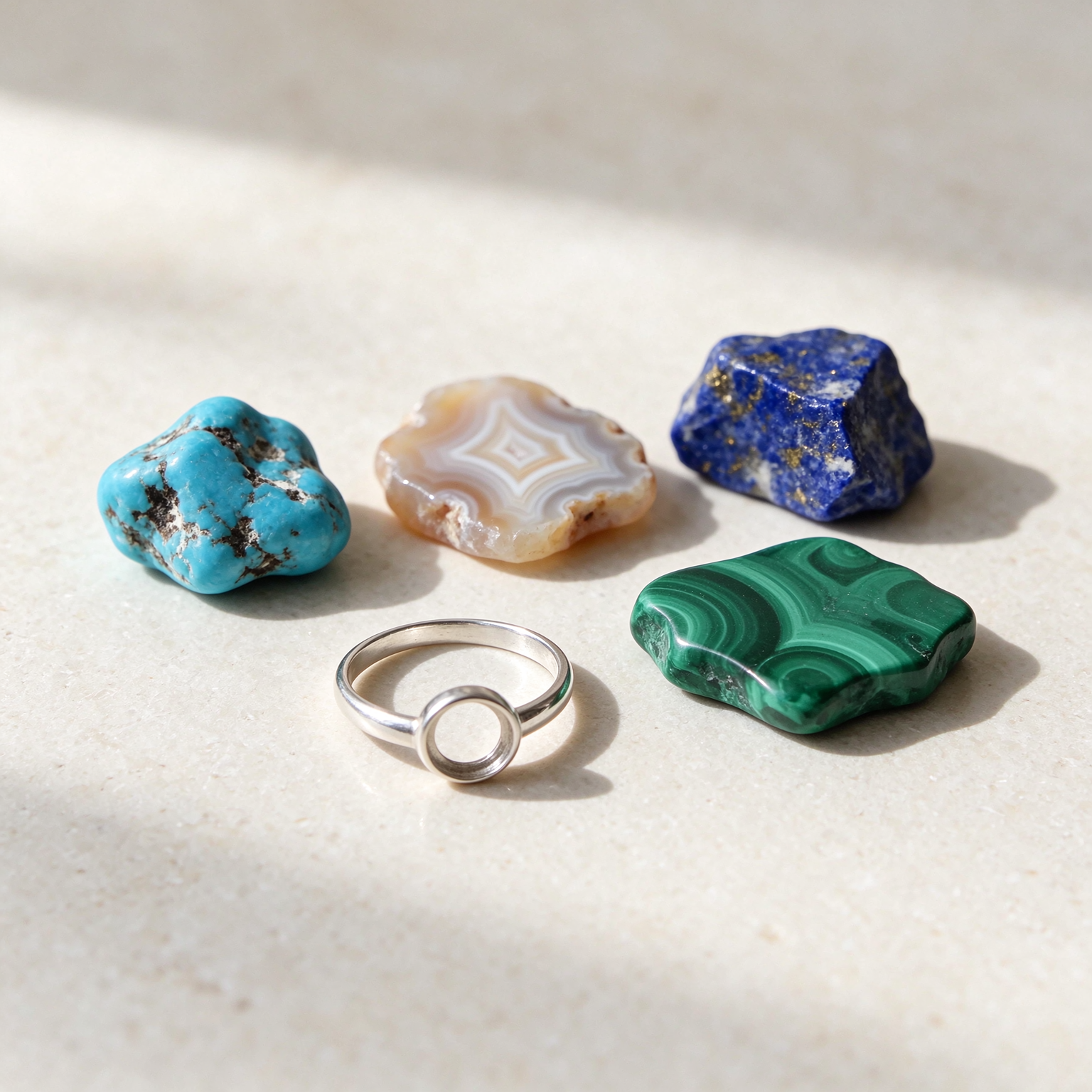
Semi-precious stones are coloured gems other than diamonds, ruby, sapphire and emerald. In 925 silver they are often used on pendants, ring faces, bracelet beads and earring accents. Turquoise brings blue-green tones for vintage and ethnic styles; agate is smooth and affordable for everyday fast movers; lapis lazuli is deep blue with gold flecks and a calm look; malachite has a distinctive green-black banded pattern. Cost and positioning differ, so quotes must name the stone rather than writing a generic gem.
Turquoise is porous and soft, absorbs sweat and oil and often gets resin-stabilised; agate is dense and hard, and colour may be dyed, so check whether it looks natural; lapis is medium hardness with pyrite gold flecks and calcite white veins, where fleck distribution is both style and a flaw cue; malachite is softer with layered banding and knocks and chemicals. Natural stones vary per piece, so bulk lines accept colour and texture differences, while custom pieces follow a sealed sample standard.
Cool silver pairs cleanly with blue-green stones and looks richer against dark stones. Turquoise and malachite suit both bright and antiqued silver; deep lapis looks crisp on bright silver and more premium on black rhodium. For clarity, everyday pieces allow minor natural texture, but cracks and pits must not cluster on the visible front. Stones within a set should share one tone to avoid a blue-green mismatch.
Soft, brittle stones should avoid exposed thin-prong settings; bezel and channel settings protect the edge better. Turquoise and malachite are knock-sensitive, so rings and bracelets favour full-edge bezels; agate wears well enough for prong and open-back designs. Leave ventilation or glue access behind the stone so it does not seal in moisture. Glue and silver edges must be neat, with no overflow over the stone face.
One, stone type and natural-or-treated status, dyed or resin-stabilised; two, shape and diameter or size in mm; three, colour grade and clarity, with the acceptable flaw range on the front; four, setting method and stone seat size; five, tolerance for colour and texture variation. Check colour, texture and security on samples, then bulk-sample against the sealed piece. Natural stones vary by batch, so confirm whether natural colour difference is accepted.
Most are mined natural stones, though some are resin-stabilised, dyed or cut and polished. The spec sheet should state natural versus treated; dyed stone must not be marketed as natural.
Agate is dense and hard and relatively scratch-resistant for daily wear; turquoise and malachite are softer and sweat- and knock-sensitive, suiting pendants and earrings with less friction.
The stone does not oxidize like plating, but porous stones darken with sweat and oil, and dyed stone may fade over time. Avoid perfume and sweat and wipe with a soft cloth to slow this.
Ask for stone type, size, colour grade and treatment in writing, then compare colour, texture and flaw position against the sample. Bulk lots are sampled against the sealed piece; re-check the whole lot if colour drifts beyond tolerance.


