

 EN

 CN
 ES

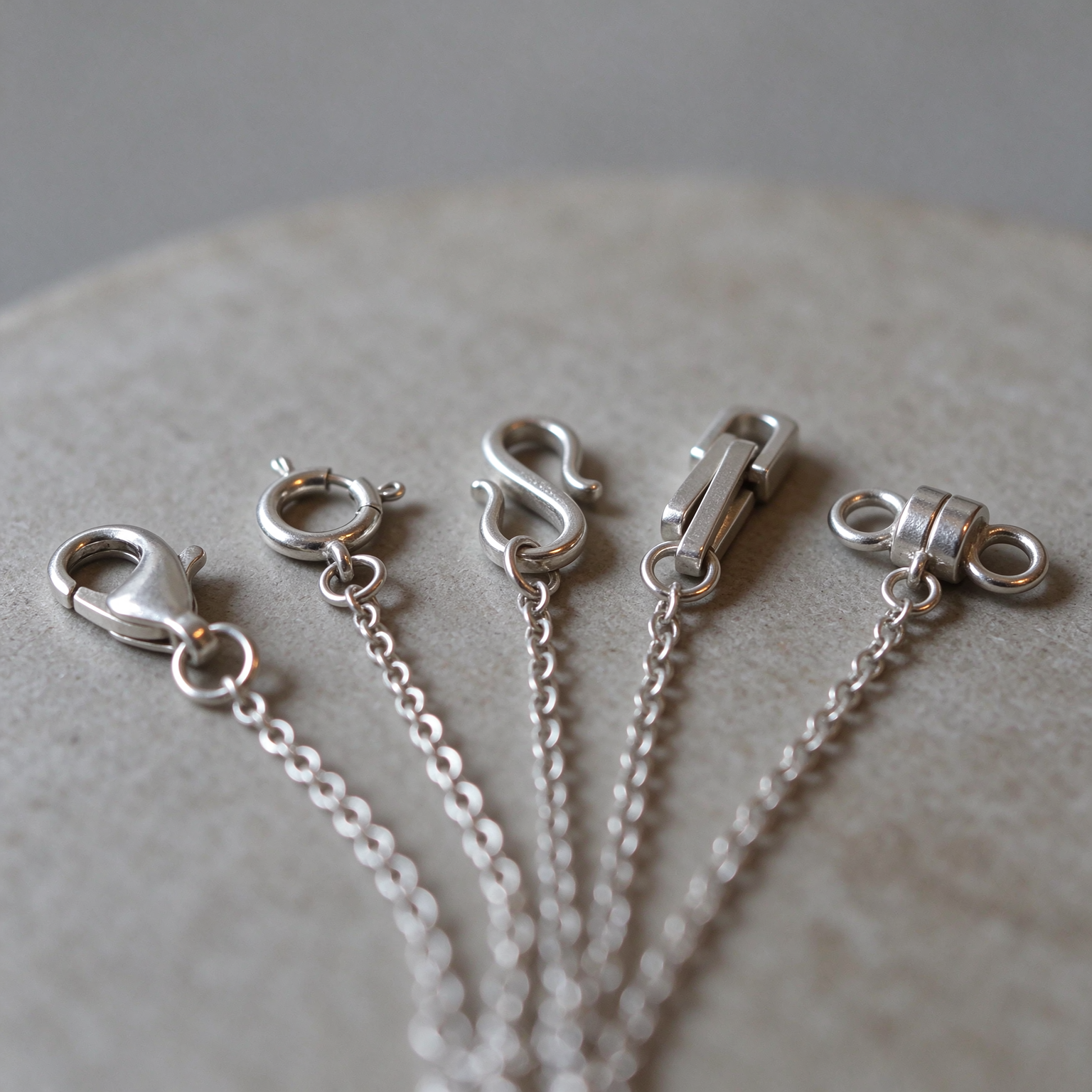
A lobster clasp uses an internal spring to drive a tongue, closing into a loop: strong and one-handed, the standard for necklaces. A spring ring is a simple ring with a spring gate, cheap but prone to spring fatigue. An S-hook relies on the metal's own elasticity, with no spring part, moderate strength and easy deformation. An interlock uses two interlocking halves with wide contact area, good for bracelets and heavier chains. A barrel clasp threads closed and is the most secure but slowest to use.
Fine chains of 0.8 to 1.2 mm take a small lobster or spring ring; oversized clasps look clumsy. Medium chains of 1.5 to 2.5 mm need a medium lobster, since spring rings deform under load. Heavy chains and bracelets take interlocks or large lobsters. The clasp opening must clear the welded chain end, or the joint snags and eventually breaks.
Lobster clasps suit one-handed wearers. Spring rings need a second hand and suit bracelets. S-hooks need no tools but fatigue under repeated bending. Interlocks demand little finger strength. Barrel clasps are secure for high-value long chains but slow. Choose by customer, not by the cheapest unit cost.
Spring ring failures are mostly spring fatigue: cheap to replace but need the same size part. Lobster tongues can be straightened, though broken springs mean replacement. S-hooks can be reset by hand, with strength dropping each time. Losing one interlock half means replacing the pair. Keep spare parts by clasp type, at no less than three percent of sales volume.
Two checks: a pull test at a load set by chain gauge, held to see whether the clasp slips; and a cycle test, opening and closing a set number of times to inspect spring return and tongue position. Write sampling ratio and pass criteria into acceptance, and trace batch-level slipping to the clasp lot rather than replacing finished pieces.
Barrel and interlock are the most secure, then lobster. For daily necklaces a lobster clasp balances security and one-handed use.
The spring is a thin wire that fatigues with repeated opening and deforms above its load. Avoid pulling a chain by the clasp.
It needs soldering or a matched part. Hand-bending S-hooks repeatedly weakens them, so use a repair service.
At least three percent of sales volume for the common types, matched to the chain gauges actually sold.


