

 EN

 CN
 ES

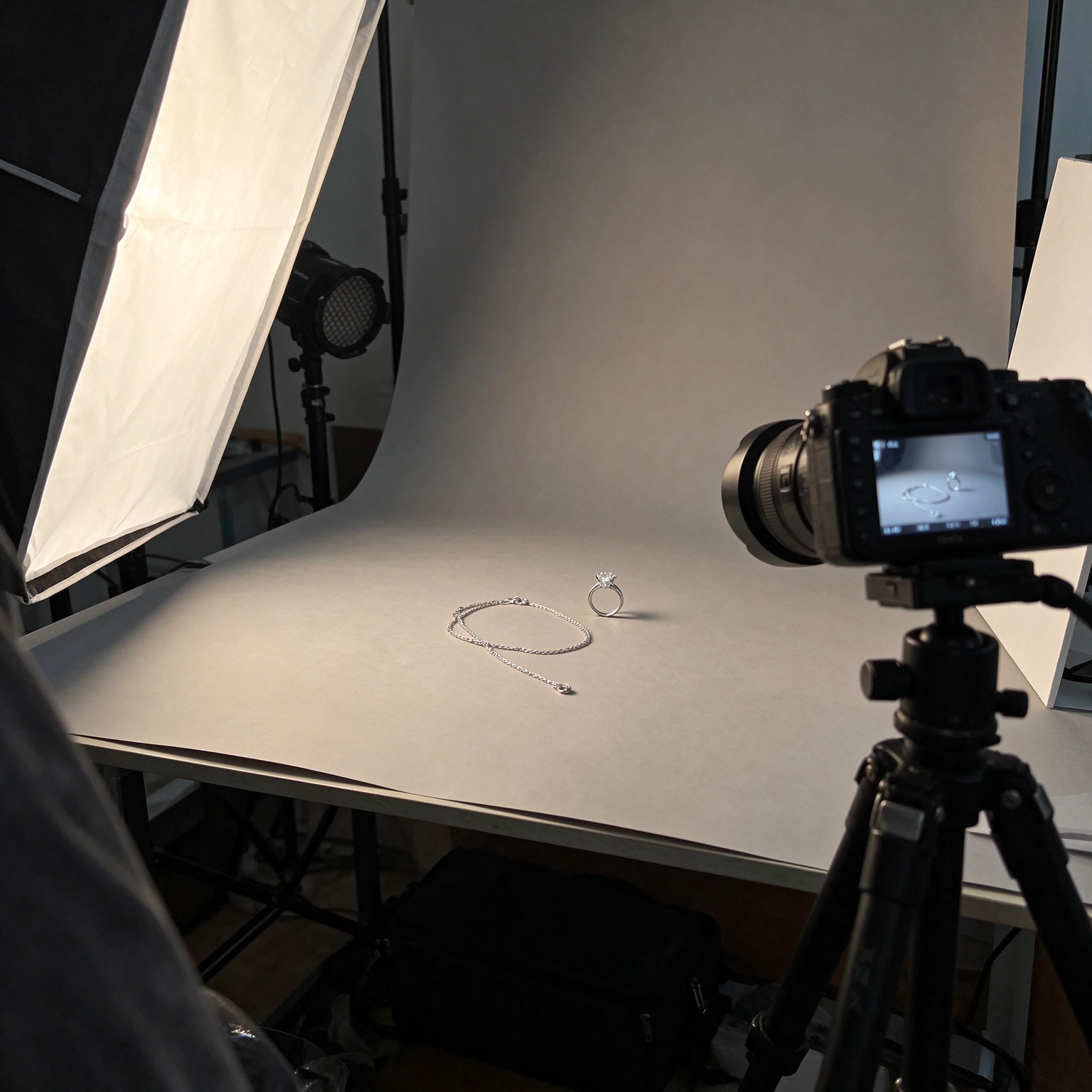
Polished metal reflects its surroundings, so white and black patches in the frame are the shapes of light sources and blockers. Enlarge the source with a softbox, diffuser or white reflector to turn a point light into an area light, giving continuous gradation instead of a blown hotspot.
Top light with two side fills is the safest setup: the top acts as key and the sides remove dead blacks. Side-backlight draws the outline, useful for chains. A ring light suits ring faces by producing an even circular highlight. Keep sources slightly above the product to avoid flat frontal light.
Light grey and warm white are versatile and calm the cool cast of silver. Pure black suits bright polished pieces but mirrors into the metal as dark blocks; pure white clips easily and needs separate background lighting. Place acrylic or matte paper beneath the piece to kill table reflections. A polariser can cut glare but flattens the metal, so use sparingly.
Silver reads cool, so 5000 to 5500 K matches the eye. Mixing lights of different temperatures splits the metal into cyan and yellow zones. Custom white balance from a grey card before shooting, then refine in post. Avoid auto white balance across a series or colours will drift frame to frame.
Phone: use the main lens rather than ultra-wide to avoid edge distortion, lock focus and exposure, disable beauty and sharpening, use two continuous lights with paper diffusion, and keep ten to fifteen centimetres for macro. Camera: macro lens at f8 to f11 for depth of field, shutter release or delay to avoid shake, RAW for latitude. Fix light positions and settings per series for consistency.
The source is too concentrated. Widen the emitting area with diffusion or a reflector so the hotspot becomes a gradient.
It depends on the piece. Bright polished silver pops against black, but black mirrors into the metal as dark blocks that need side light.
For regular uploads, yes. Locking exposure, disabling sharpening, adding diffusion and fixing distance matters more than the body.
Fix light position, colour temperature and white balance, calibrate with a grey card, and batch-process with one setting.


