

 EN

 CN
 ES

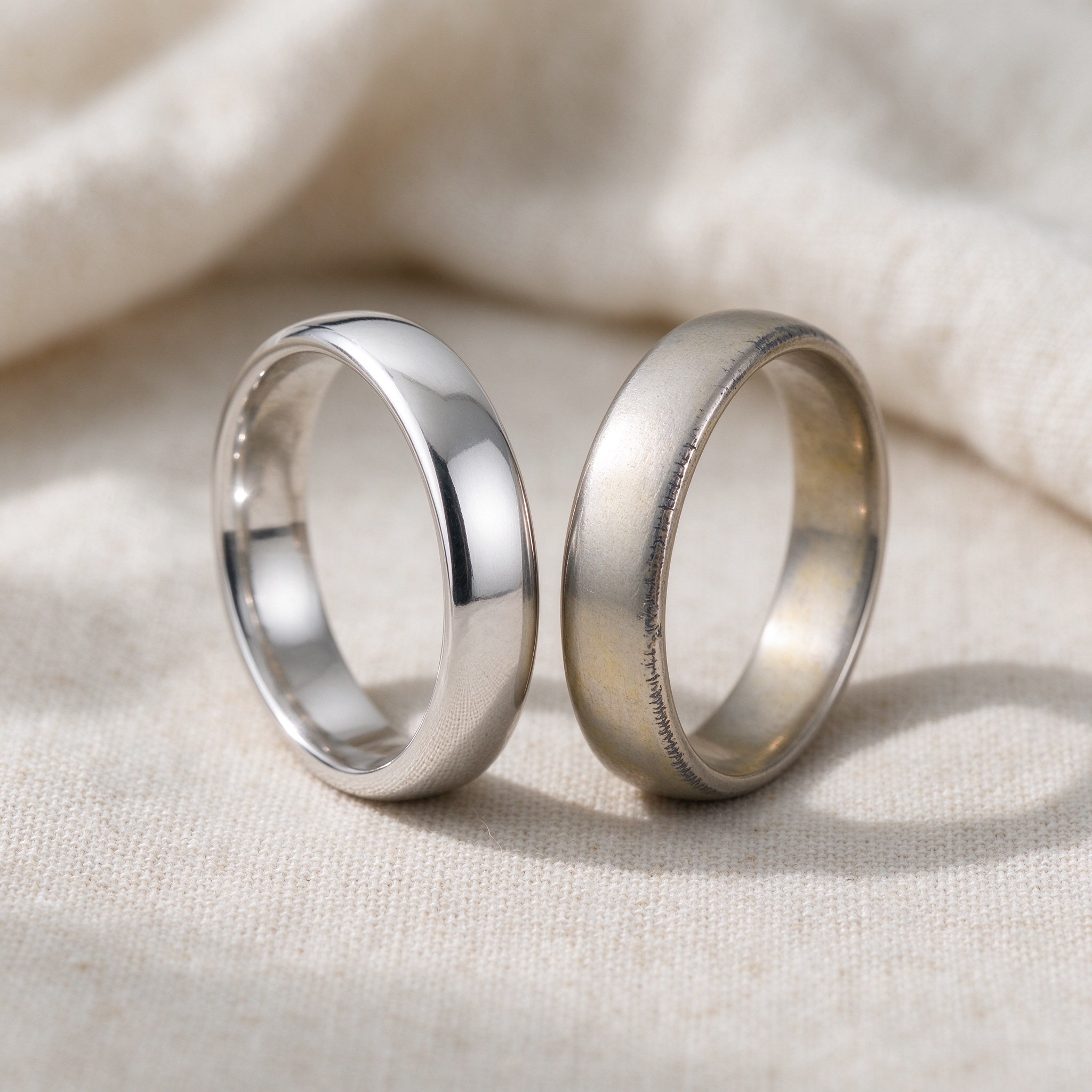
First, coating worn through, exposing silver or copper alloy beneath: edges brighten then darken, most often on ring inner bands and bracelet contact points. Second, poor adhesion: blistering or sheet-like peeling with a sharp boundary, usually from incomplete pre-treatment or contaminated plating baths. Third, tarnish on the silver itself: no peeling, just a shift from bright white to yellow then black, common around sulfur exposure. Each cause has a different responsible party, so a wrong diagnosis sends the claim to the wrong place.
Rhodium typically runs 0.03 to 0.1 micron. Too thin and wear resistance drops; too thick and cost rises while stress cracking becomes likelier. Adhesion depends on pre-treatment: degreasing, acid pickling, activation and strike plating each have to be complete, or the coating fails later. A post-plating sealer slows tarnish noticeably but is not permanent, since friction and chemicals consume it over time.
Sweat with salt and lactic acid, perfume and sunscreen with alcohol and solvents, hand soap and sanitizer gels, hot springs and pools with sulfur and chlorine all accelerate coating loss and tarnish. Habits matter too: wearing pieces in the shower, during workouts or while cleaning shortens coating life. This is not a defect but a use case outside the coatings design range, and it should be explained to end customers.
Four hard measures: standardize pre-treatment and keep inspection records; set plating thickness by use, thicker where friction is constant; add a sealer and run adhesion tests such as tape pull or bend tests; and run salt spray or artificial sweat simulation before shipping. For bulk, also check plating uniformity at solder joints, settings and inner bands, where current distribution is weakest.
Diagnose by symptom first. If it polishes back bright and a black residue comes off, it is tarnish and a silver cloth or professional clean will restore it. Sheet peeling with a clean boundary is an adhesion issue, a batch defect that calls for replacement or rework. Local wear-through is abrasion, fixable by re-polishing and re-plating. For wholesale accounts, write these three categories and their responsibility split into the after-sales terms so each claim does not reopen the argument.
Not always. Sheet peeling is a batch defect; local wear-through is normal abrasion; overall darkening is usually tarnish on the silver, restorable with a polishing cloth.
Commonly 0.03 to 0.1 micron. Too thin loses wear resistance, too thick raises cost and stress cracking risk, so thickness should follow the wear scenario.
Worn coating can be re-polished and re-plated; sheet peeling needs factory rework; tarnish usually restores with a polishing cloth or professional cleaning.
Remove pieces before showering, workouts and cleaning, keep perfume and sanitizer off the surface, store sealed against sulfur, and wipe with a soft cloth.


