

 EN

 CN
 ES

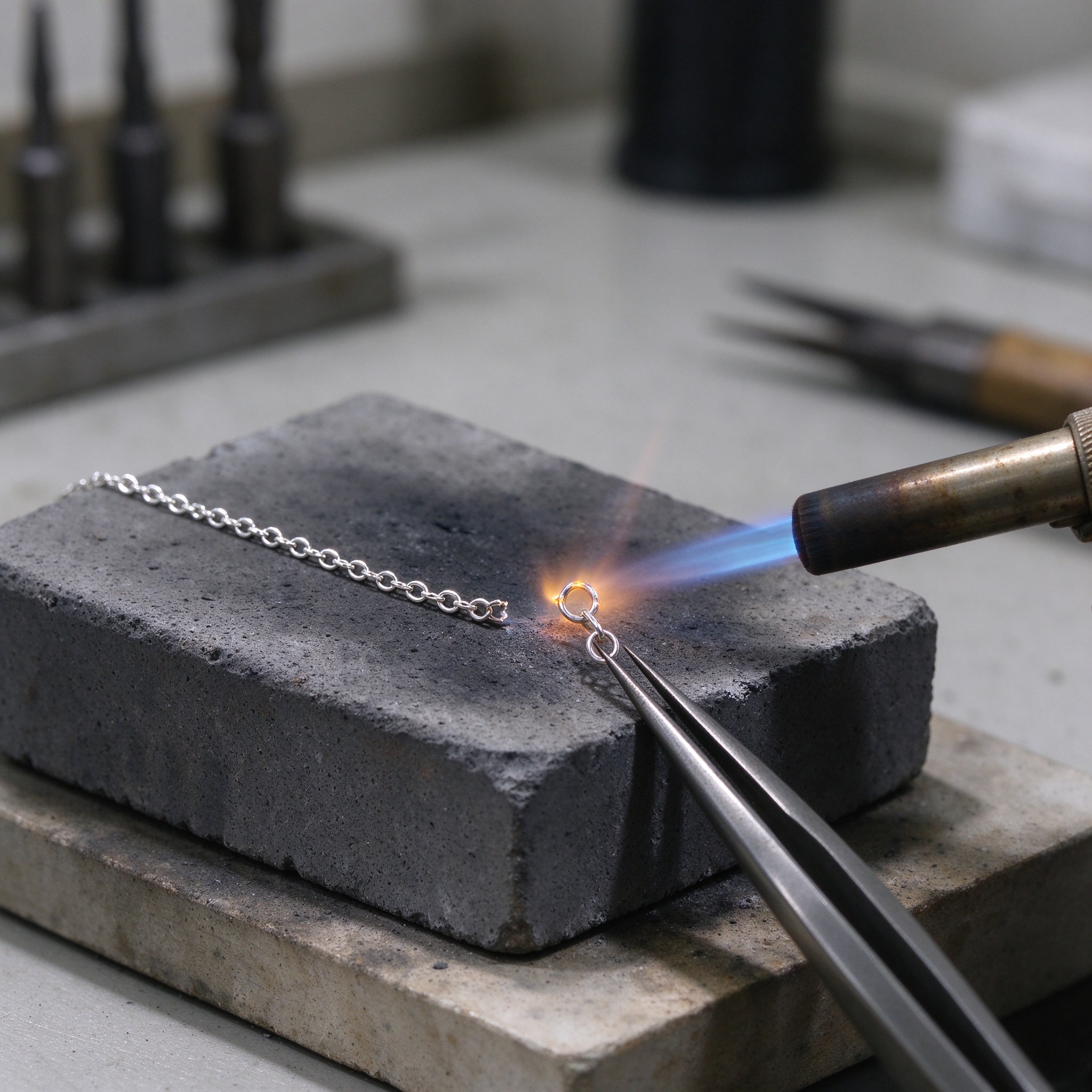
Repairable: solid bands resized, broken chains re-soldered or re-clasped, loose prongs re-tightened, surface wear re-polished. Not advisable: hollow thin-wall pieces that collapse under heat, pavé-heavy pieces that lose stones when heated, bands already resized twice and now fatigue-prone, and die-cast pieces whose structure has already distorted. The test is simple: is there enough wall thickness, will the stones survive heat, has the metal already fatigued.
Sizing down is easier: cut a section, weld, polish. Sizing up needs added metal, and a solid band typically moves one to two sizes; beyond that the seam shows, the inner surface goes uneven and strength drops. Stone-set bands must be resized away from the setting to protect the stones. Engraving inside is lost when sizing down, and sizing up can leave a join line. Always re-polish and re-plate after resizing, or a color band appears.
Look at the break point first. A break mid-link can be re-soldered or bridged with a small ring; a break at the clasp or extender is usually better solved by replacing the clasp. Chains under about 1 mm lose strength after welding, so bridge the break with a small connector to spread load. Welding creates a heat-affected zone and the joint darkens on plated chains, which needs local or full re-plating. Say this in the quote, or the customer reads the dark spot as a failed repair.
Polishing removes surface scratches, oxidation and light wear and brings back brightness, but it cannot remove deep scratches or dents. Polishing is subtractive: it removes metal, so dents only become relatively more visible. Repeated polishing thins the piece and softens inner-band engraving and stamps. Limit polishing and rely on a polishing cloth and gentle cleaning for daily upkeep.
For bulk rework use six steps: log style and issue, photograph and classify, quote the fix, get approval, repair, re-inspect. Cost is usually labor plus added metal plus re-plating, and re-plating often exceeds half the total. For wholesale accounts, define what is covered in warranty, such as solder failure, and what is billable, such as user deformation or abrasion. Setting that boundary up front removes most of the back-and-forth.
A solid band typically moves one to two sizes, and sizing down is easier than up. Beyond that seams show, the inner surface goes uneven and strength drops. Hollow pieces are not advisable.
Usually yes. A mid-link break can be re-soldered or bridged; a break at the clasp is better solved by replacing it. Joints darken and need re-plating.
Welding heat destroys local plating, so the piece needs local or full re-plating; resized bands also need re-polishing and re-plating.
Yes. Polishing removes metal, and repeated polishing thins the piece and softens inner engraving, so keep daily care to a cloth and gentle cleaning.


