

 EN

 CN
 ES

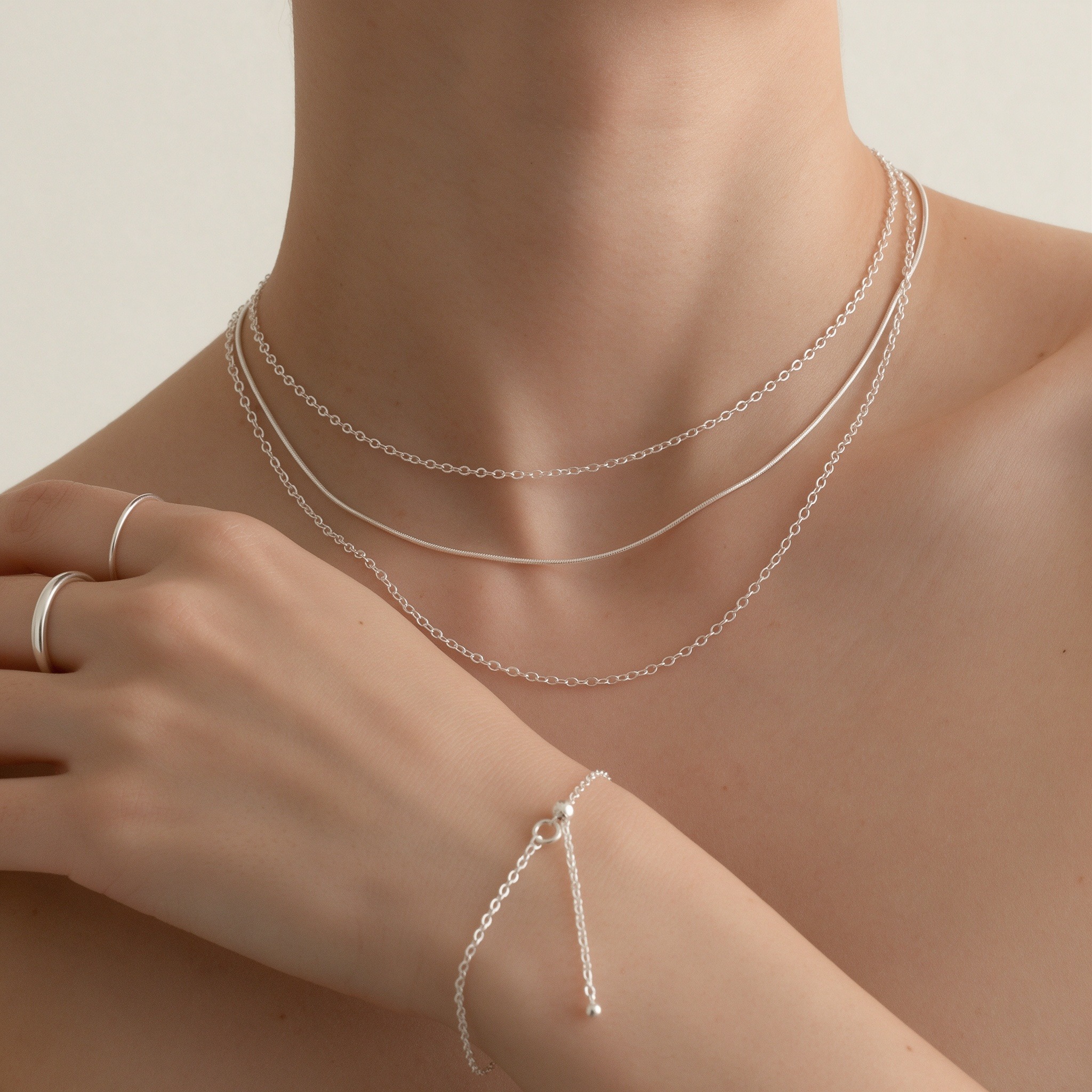
The usual failure is wanting every piece seen. Decide the lead piece first, normally the heaviest, most designed or stone-set one, and let the rest support it. The lead sets the visual centre of gravity; the others fill space and add rhythm.
Position matters too: the neck lead usually sits just above the centre of the collarbone, the hand lead on the outer wrist. Once fixed, other lengths and gauges have a reference.
Two chains of identical length fight each other and read as one thick line. Stagger by two to four centimetres, for example 40, 43 and 45, to create steps. Graduate the gauge as well: thinnest closest to the neck and slightly heavier at the longest, or reverse it so the outer layer becomes the lead.
Keep one pendant. Several pendants collide, tangle and split focus. If you must have more, choose clearly different sizes and hang them at different lengths.
Stack two or three bracelets, in a thin, medium, thin or thin plus heavy pattern rather than three of equal weight. With a watch, treat the watch as the lead, add one fine chain only, and place it on the palm side to reduce rubbing.
Do not fill every finger. A common split is one ring on the index and one on the ring finger, or two stacked on one hand offset at the knuckle. Wide bands on adjacent fingers look crowded. Space makes the hand look slimmer than filling it.
All-silver is the safest: polish, matte and brushed can mix, but let one dominate at seventy percent or more and use the rest as accents. Silver with zirconia also works if the stones stay in one colour family. When mixing antique and bright pieces, put the antique outer or as the lead, otherwise the bright finish overwhelms it.
Mixing silver and gold is a legitimate advanced move, but control the ratio, usually thirty-seventy. Fifty-fifty reads as indecision. Use a warm silver, antique or matte, as the bridge; it transitions to gold more naturally than bright silver.
First, too many highlights: bright chain, bright ring and bright watch together turn the photo into reflections with no hierarchy. Second, overlapping lengths: two chains of similar length keep crossing into one line as the model moves. Third, crowded rings: four fingers in a row make the hand look short and thick.
One more for product shots: keep the background clean. Silver reflects strongly and patterned backgrounds eat the detail, which matters most for marketplace main images.
Two or three for daily wear, up to three for shooting. Beyond three they tangle and each looks thin. The essentials are a two to four centimetre stagger and a clear hierarchy of gauge.
Yes. Control the ratio, usually thirty-seventy so one colour leads, and bridge with matte or antique silver, which transitions to gold more naturally than bright silver.
They do, especially at similar lengths and when both are snake or cable. Stagger the lengths, mix constructions such as one snake with one box, and remove them for sleep and sport.
Three moves: one lead piece, staggered lengths, graduated gauges. With those, even four pieces look ordered; without them, two look cluttered.


