

 EN

 CN
 ES

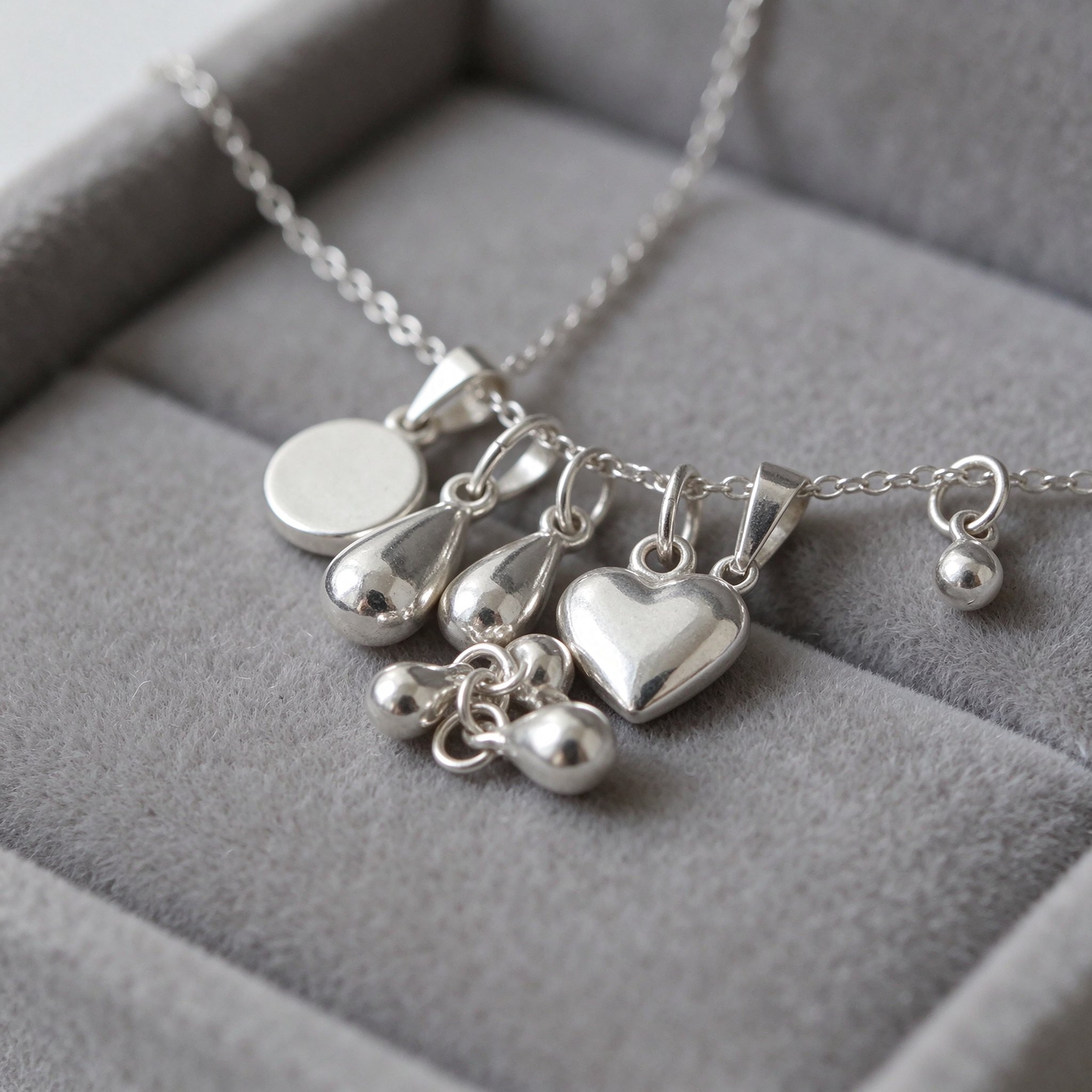
Pendants split into single-stone, cluster and design pieces: one stone highlights a single center, often round, heart or pear; clusters pave small stones into patterns; design pieces use animals, symbols or letters with stones as accents. Stone position sets the visual weight: a high bail suits a vertical drop for length, a low bail suits a horizontal piece for stability. Pick the line by wear scenario: small single stones for commuting, hearts or clusters for gifts and memorials.
Prong settings hold the stone with metal claws, letting light through and making the stone look larger, but tips must be tucked flat to avoid snagging. Bezel settings wrap a metal rim around the stone for a secure, low-key look suited to rubbed pieces. Pavé presses small stones into the tray with tiny pins for clusters. Larger stones need enough claws and rim thickness; soft or fractured stones should not be pressed tight by deep prongs. Check the stone seat matches the stone, neither loose nor chipped.
A fixed bail joins the pendant body in one piece, simple for light small drops; a moving bail links through a ring so the pendant turns with motion and shows more faces, but the connector ring must be thick enough. The bail channel should glide smoothly without catching links. Large or thick-stone pendants benefit from a moving bail to spread stress and stop the body-to-bail joint snapping. Pull the bail and joint on samples to spot weak solder, cracks or bend.
Common women lengths run 40 to 45 cm, choker at the collarbone, longer dropping to the chest. Small pendants pair with slim chain (1 to 1.5 mm), large ones with heavier wire (1.8 mm up) to balance weight. The heavier the drop, the thicker chain and bail must be together; do not hang a heavy drop on a slim chain. In a set, pendant and chain share one metal colour, and the chain stays simple so it does not compete with the face. Quotes should state drop weight, suggested wire thickness and compatible chain length.
Check five points: fit between stone size and seat; bail thickness and ring diameter; drop weight against suggested chain thickness; setting security, prongs, bezel and pavé; even polish and plating. On samples, pull the bail and gently swing the drop to see whether the joint takes force evenly. Bulk sampling checks weight drift per model, bail-channel smoothness and stone tightness, so drops do not sit crooked or stones come loose on arrival.
The bail rarely snaps on its own; the common fault is weak solder or a too-thin ring that cracks under pull. Pull the sample to check weld and ring thickness, then bulk-check load to the same standard.
A heavy drop needs a chain over 1.8 mm to balance weight; a slim chain stretches or snaps the bail under a heavy drop. State drop weight and suggested wire thickness in the quote.
Light small drops use a fixed bail for simplicity; large or thick-stone drops use a moving bail to spread stress and reduce joint breakage. The connector ring must be thick and the channel smooth.
Match stone diameter and thickness against the seat: stone stays put without chipping the rim. On samples inspect prong or bezel fit; bulk-check stone tightness is consistent across the lot.


