

 EN

 CN
 ES

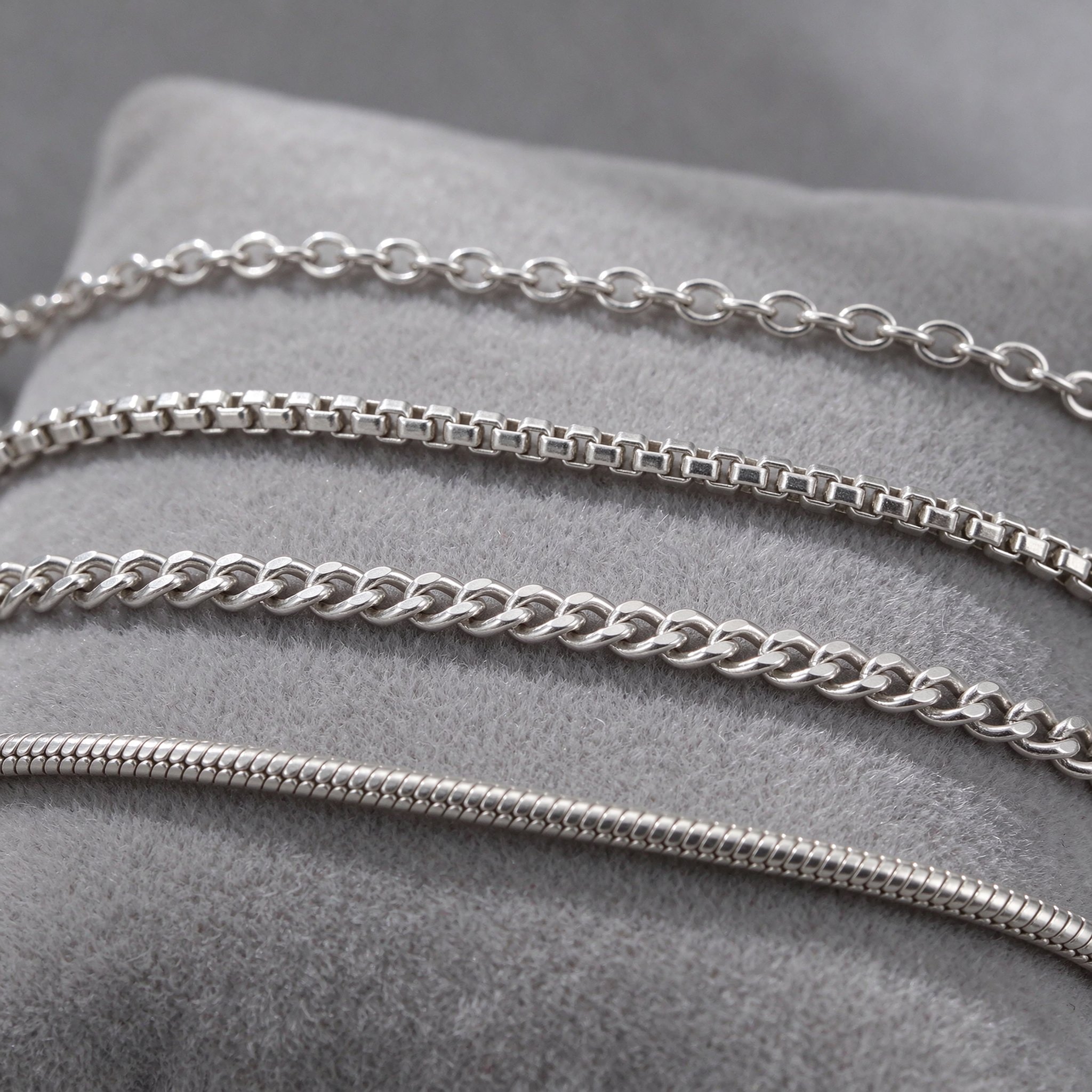
Cable (O-link) chains interlock round links, a basic stable structure that holds pendants reliably. Box chains join square links, flat-cut and bright for a refined look. Herringbone links twist flat with soft reflection against the neck. Snake chains stack thin sheets into a smooth line but are brittle under force and hate bending. Curb chains cross chunky links for a street look with strong load. Oval (belcher) links sit flat and even, classic and durable. Pick style first: cable or box for commute, herringbone or snake for a slim neckline, curb for a heavy look.
Hanging a pendant depends on matching chain load to drop weight. Cable and curb links bite deep, carry medium drops; snake chains hold little and suit no drop or a very light charm; herringbone and box sit in between. The heavier the drop, the thicker the chain and clasp must be together. A slim chain under a large drop stretches links or snaps the clasp; samples should be pulled with the matching weight to test links and clasp. Pendant-free necklaces can stay slim by style; pendant necklaces prefer a load-safe link type.
Women chain thickness commonly runs 1 to 2.5 mm: slimmer is finer but weaker in load; 40 to 45 cm sits at the collarbone, over 50 cm drops to the chest. Daily commute uses 1 to 1.5 mm slim chain with a small drop; gift and styling pieces may go over 1.8 mm. Length also sets drop position: the pendant lands on collarbone or chest depending on chain length. Stock two to three length tiers; bracelet chain can be slimmer than necklace chain to avoid looking bulky on the wrist.
Necklace clasps include lobster claw, spring ring and fishhook toggle. Lobster claws open easily and hold securely; spring rings are light but the spring fatigues; toggles suit close-fitting neck chains. Clasp-to-tail joins must be welded tight, with enough extender links to adjust length. A tail bead or small charm finishes the end and acts as a stop. Check clasp springback, weak solder at joins and smooth movement of every extender link. Sensitive designs should label clasp material too, to avoid alloy-contact irritation.
Stock splits into chain type, length and thickness tiers, with core styles taking the largest share. Checks cover batch thickness tolerance, even link bite, clasp security, plating evenness and length tolerance. Match necklace and bracelet style as a pair. Samples hang drop weight and work the clasp repeatedly to spot tangling or twisting tendency. Bulk sampling checks link flatness, clasp springback and surface shine against the sealed sample, so arrivals are not twisted or loose-clasped.
Cable O-link chains are stable and load-bearing, suiting most pendants and daily outfits, and are the core wholesale stock; add curb, herringbone or snake for styling.
Snake chains hold little and hate bending; suit them to no drop or a very light charm. A medium-plus drop easily deforms or snaps them.
Small drop with 1 to 1.5 mm slim chain, medium with 1.5 to 1.8 mm, large with over 1.8 mm on a load-safe type. Pull-test the matching weight on a sample before ordering.
Often links are too fine, or herringbone and snake neck chains wrap themselves. Store hanging separately; bulk-check link flatness and twist tendency.


