

 EN

 CN
 ES

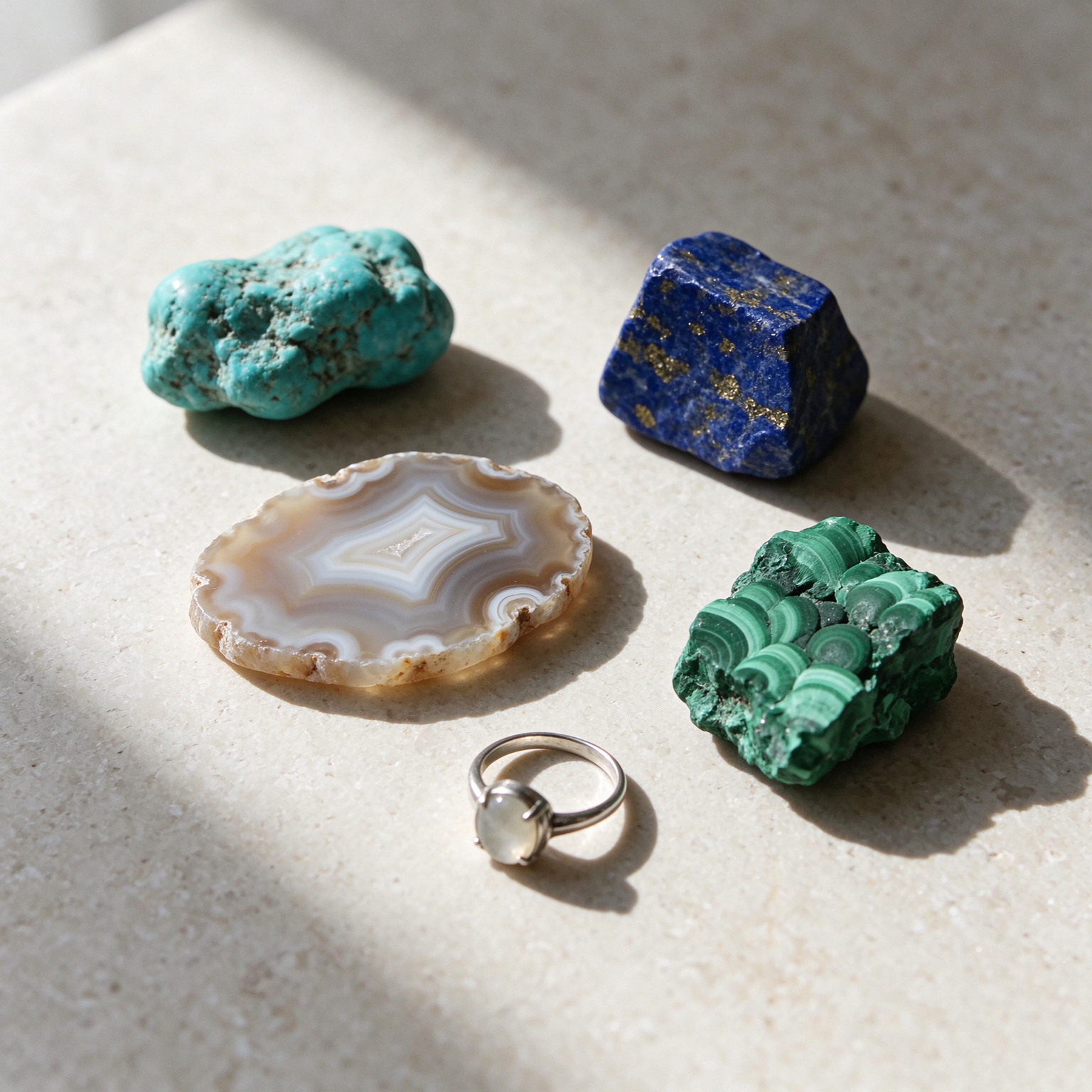
The Mohs scale ranks ten standard minerals from one to ten; higher values resist scratches from harder objects. Hardness is scratch resistance, not impact resistance: a hard quartz-type stone can still be brittle and chip on a fall. Judge durability on both hardness and brittleness, then consider whether the stone sits on a ring or bracelet that rubs daily, or on a pendant and earring with less friction.
Agate and chalcedony are dense, around 6.5 to 7 and fairly wear-resistant; lapis lazuli is about 5 to 5.5 with pyrite and calcite, soft and scratch-prone; turquoise is 5 to 6, porous and clearly brittle; malachite is 3.5 to 4, soft with banded layers and knock-sensitive; pearl is organic, only 2.5 to 4 with a thin surface layer that scratches and reacts to acid and sweat. Cubic zirconia and crystal types are harder, but brittleness is assessed separately. Quotes should name the stone and hardness range instead of a generic gem.
Ring faces and bracelet beads contact desks and clothing most, so agate, zirconia and crystal suit daily wear; turquoise, malachite and pearl fit pendants, earrings and brooches with less friction. Within one set, place soft stones on low-stress positions and hard stones where rubbing is constant. For rings and open bangles that deform easily, leave stone-edge clearance so bending cannot crack the face.
Bezel and channel settings wrap the stone edge in silver and protect soft brittle stones best; prong settings expose the face for sparkle but leave edges and tips open to knocks. Knock-sensitive turquoise, malachite and pearl favour full or partial bezels; wear-resistant stones can use prongs to show fire. Leave ventilation and glue access behind the stone so it does not seal in moisture, and keep glue off the polished face. Open rings and moving pendants need slack in the seat so opening and closing does not squeeze the stone.
One, stone type and natural-or-treated status, dyed, stabilized or coated; two, hardness range and brittleness note; three, setting method and seat size; four, wear position, everyday piece versus accent; five, durability acceptance expectations and allowed wear range. Check colour, security and edge fit on samples, then bulk-sample against the sealed piece. Note care advice for soft brittle stones on the listing to reduce after-sale disputes.
Not always. Hardness only covers scratching; brittle stones chip even when hard. Check hardness, brittleness and wear position together, and pick tough stones for rings and bracelets.
Agate, chalcedony, cubic zirconia and crystal are harder and relatively scratch-resistant for everyday lines; turquoise, malachite and pearl are softer and suit pendants and earrings with less friction.
Pearl is organic with layered calcium carbonate and low hardness, so hard objects mark it and acidic sweat dulls the nacre. Wipe with a soft cloth after wear, avoid perfume and lotion, and store separately.
Compare against the sample for chips, cracks and glue overflow; shake gently to test the seat; on bezels check the rim hugs the edge. Sample bulk lots against the sealed piece and re-check the lot if loose stones or cracks cluster at one station.


