

 EN

 CN
 ES

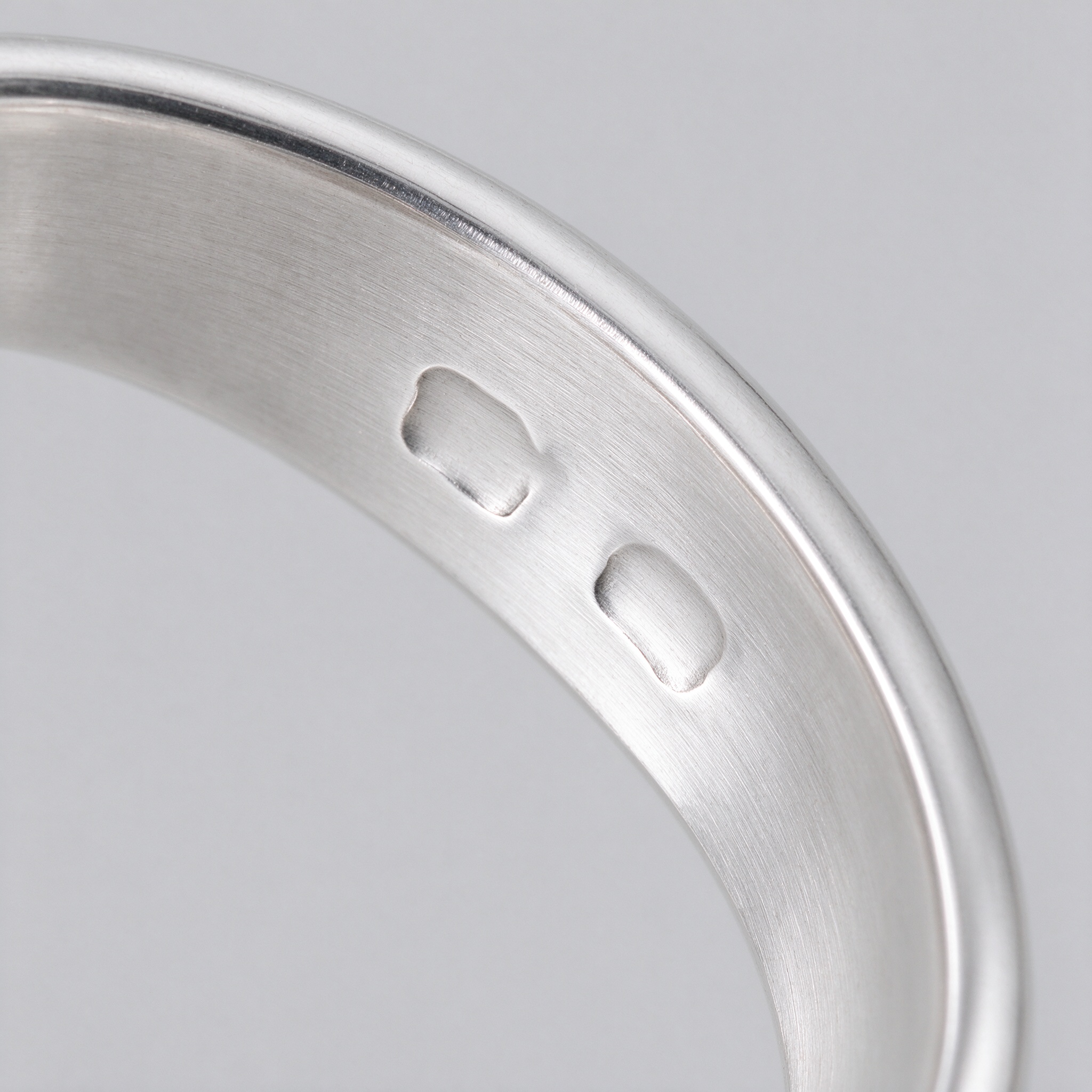
925 is a parts-per-thousand purity mark: 925 of every 1000 parts are silver, or 92.5 percent, with the balance usually copper. Fine silver at 999 is too soft for rings, studs and thin chains, so the trade standardises on 925 as the base for jewelry, known as sterling silver. It is not fine silver, and scrap value is not calculated as fine silver; the alloy trades purity for strength. In jewelry usage, 925 silver, sterling silver and solid silver generally refer to this same material.
Typical locations are the inner band of a ring, the reverse of a pendant or the side of its bail, the inside of a bangle, behind an ear stud, and on the tag of a chain clasp. Two processes are common: laser engraving, which holds fine detail in a small area, and die stamping, which gives a deeper relief but is limited by position and metal thickness. There is a legibility floor: characters under roughly 0.8 to 1 mm, or marks on a tight curve, are hard to read, and thin-wall pieces can be punched through. A missing mark on a tiny stud or a fine chain link is therefore a process limit, not proof of anything.
Rules differ by market. China applies precious metal purity naming and marking rules that require material and fineness. Most EU countries require a purity mark plus a maker responsibility mark, and items in prolonged skin contact fall under nickel release limits tested to EN 1811 with EN 12472 simulated wear. The US requires imported precious metal jewelry to carry a quality mark and a maker or trader mark, and children jewelry adds CPSIA lead limits. For export orders, put mark content, position and character height into the approved sample before bulk, not after.
No. Thin-wall, small or finely openworked pieces cannot carry a stamp; handmade and vintage pieces may never have been marked; imported goods may use another system, showing only STERLING or Ag925. The reverse is also true: a 925 stamp does not prove solid 925, because a mark is applied, not a material certificate. Judge the object instead: colour should be white and bright, weight should feel solid for its size, a magnet should not attract it (silver is non-magnetic, though findings may contain steel), and worn areas should not expose a brassy or reddish base.
Plating puts a silver layer over copper, brass or nickel silver; filled pieces wrap a silver skin around a core. Three practical tells: check the cross-section and worn spots, since inner bands, clasps and pendant edges wear first and expose a yellow or red base; compare weight, because a copper core is roughly 10 to 20 percent lighter for the same volume and feels light in hand; and compare price, because a finished piece well below the silver rate cannot be solid. Confirmation needs testing such as density, X-ray fluorescence or a destructive section, so for sourcing the practical step is a material declaration plus a sealed reference sample per lot.
It depends on use. 999 is purer but soft, suited to bangles and objects. 925 with copper is harder and suits rings, studs and thin chains that must resist deformation.
Yes. Long wear, repolishing and resizing all shallow or erase marks, which is why a stamp alone should never be the basis for judging material.
No. A mark records a claim, and plated pieces can carry 925 too. Check colour, weight, base metal at worn edges and, when needed, assay results.
It depends on plating thickness and wear. Areas in constant contact with sweat, perfume or friction expose the base first. It is not solid silver and cannot be cared for like one.


