

 EN

 CN
 ES

Measure the narrowest part of the wrist, one to two centimetres above the wrist bone, not on the bone and not at the base of the palm. Wrap a soft tape flat against the skin, snug enough that one finger slides under. Without a tape, use paper and a ruler, but paper buckles, so measure twice and average. Avoid measuring after exercise, after a hot shower or in hot weather; the wrist reads one to two millimetres larger in all three.
The trade convention is to add 1.5 to 2.5 cm to the wrist measurement to get total chain length. Soft structures such as fine chains and bead chains take the lower end, 1.5 cm; stiffer snake chains, flat chains and pieces with charms take 2 to 2.5 cm or they bite. For the snug look that has been popular in Europe and the US, add 0.5 to 1 cm and accept that the bracelet will rotate. Write the allowance into the spec sheet, or three production runs of the same design will differ by two centimetres.
Open and closed bangles have to pass the widest part of the hand, the knuckle line, not the wrist. Measure with fingers together and thumb against the palm: either the circumference at the widest knuckle point or the straight width across the palm. For an open bangle, check that the gap clears the palm; a closed bangle must pass the whole hand before settling on the wrist. Comfortable bangle diameter is usually 1 to 1.5 cm larger than the wrist measurement: too small and it will not pass the knuckles, too large and it spins.
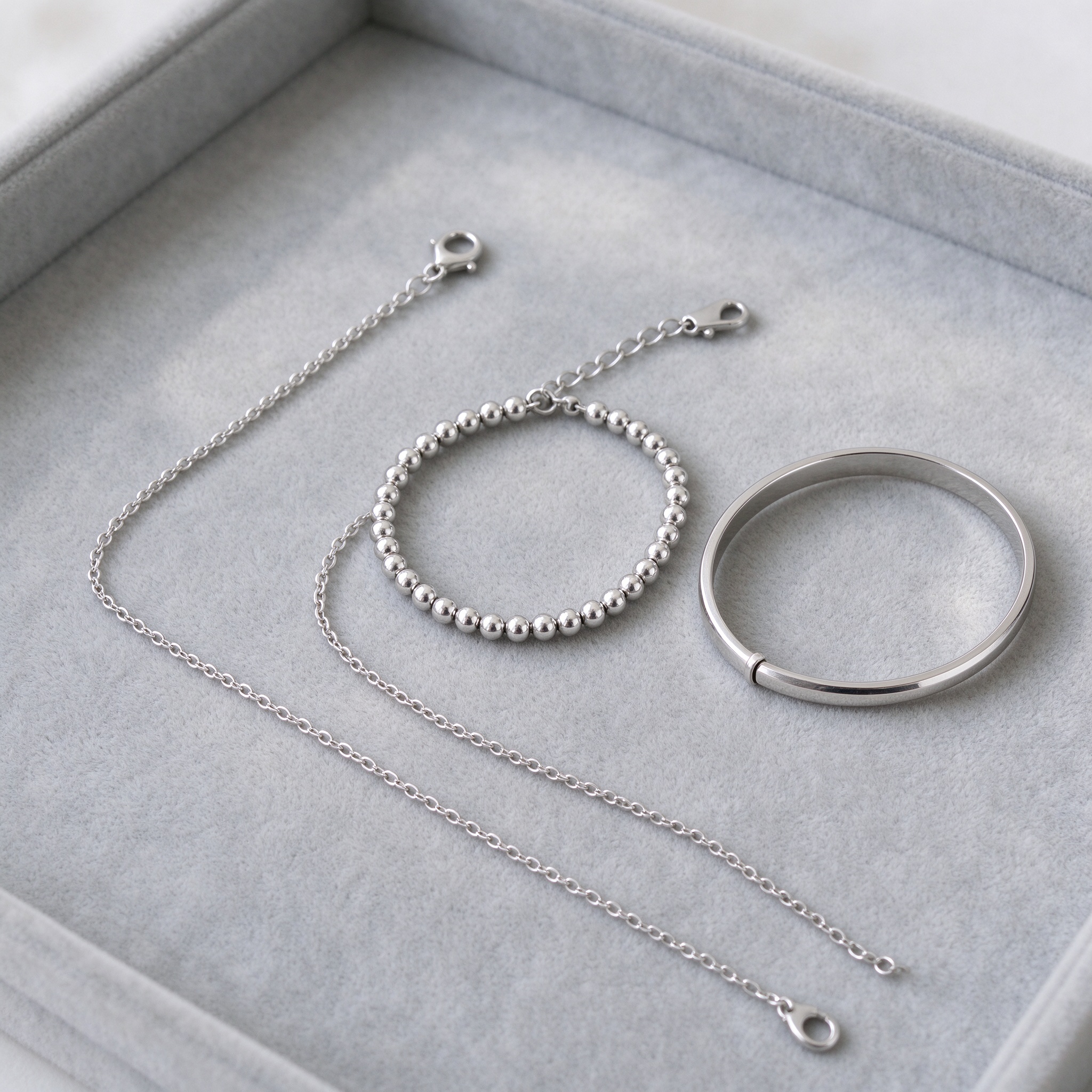
Lobster clasp plus extender is the most common combination in cross-border orders, with 3 cm and 5 cm extenders as the usual options. Spring clasps are clean but not adjustable, so sizing must be exact. S hooks and slider clasps adjust continuously and suit fine chains, though they drift during wear. Magnetic clasps are convenient but load-limited and pop open under a heavy charm. Decide adjustable versus clean first, then set the length, rather than the other way round.
When stacking two or three, the innermost sits at the wrist and the outer hangs, so add one to two centimetres of allowance over a single bracelet. Heavy chains and charms stretch visually, so take a little back. For production, carry three or four core lengths plus extenders as a component instead of a full size run. The chart should state the measuring method (wrist or palm), the allowance, total length including clasp and extender length; a printable size card cuts customer service disputes sharply.
In principle yes, but method changes the number. Measure one to two centimetres above the wrist bone, flat and not tight, or you will read one to two centimetres small.
About 18 cm in a chain bracelet, 17 cm for a snug look, and 18.5 to 19 cm for stiff chains or charms. A 17 cm main chain plus a 3 cm extender is the safest option.
Yes, and that is the most common bangle return. A closed bangle must clear the knuckles, so diameter runs 1 to 1.5 cm above the wrist measurement; broader palms should choose an open bangle.
Three or four: 16, 17 and 18 cm plus one adjustable with a 3 cm extender. Too many sizes creates broken-size gaps; extenders cover the range better.


