

 EN

 CN
 ES

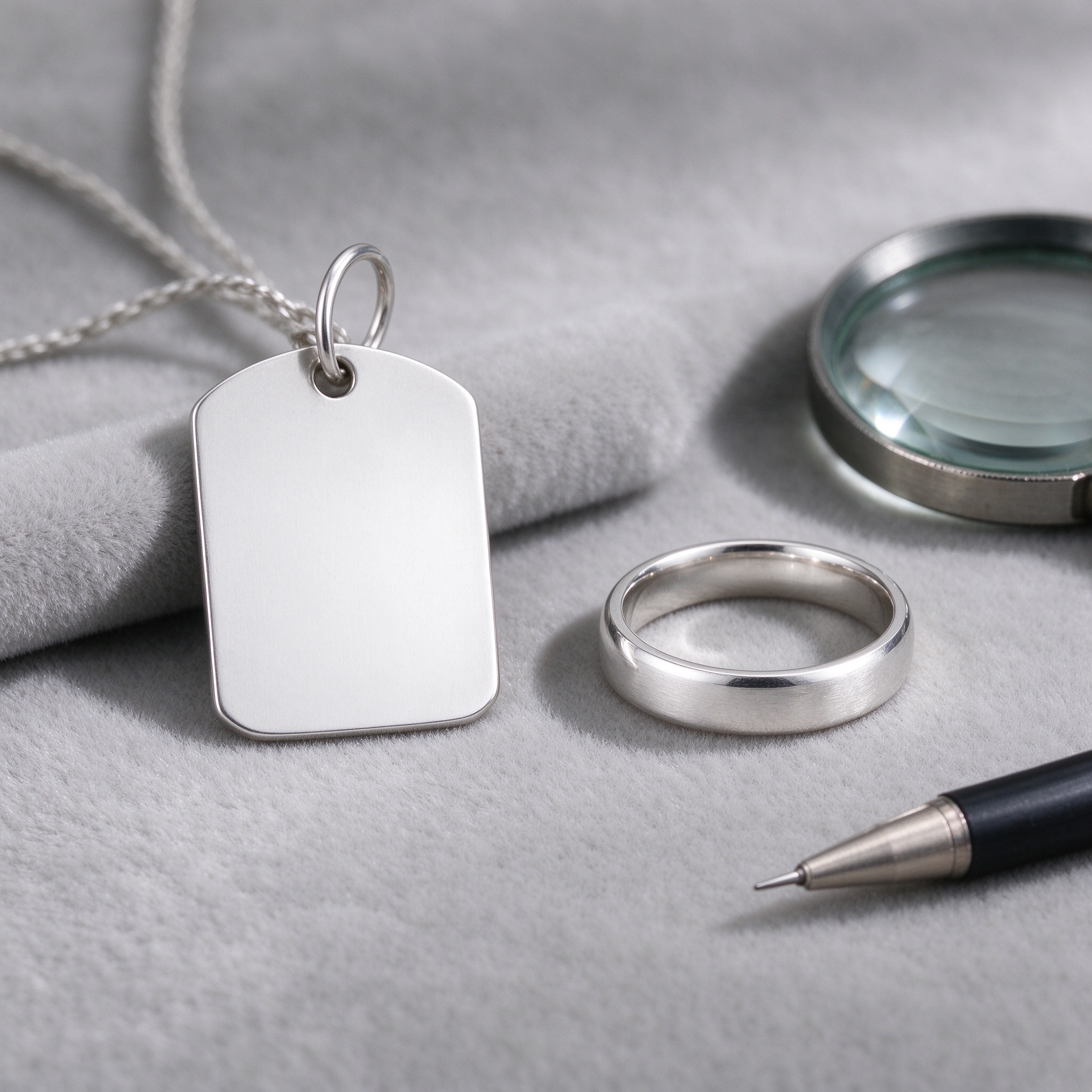
Laser engraving focuses a beam to ablate the surface. It handles fine and small lettering plus complex graphics, down to about 0.8 mm cap height, with a slightly rough, grey-white edge that usually needs no post-finishing. Diamond-cut engraving cuts with a tool, giving sharp, metallic lettering on wide plain bands, though the ends of a curved run can come out shallow. Hand chasing is struck point by point with a chisel: the most artisanal look, suited to larger characters and graphics, at higher cost and longer lead time. None is universally better; character count, depth and budget decide.
Available fonts are usually a handful of system faces. Sans serif holds small sizes best because strokes are even. Serif faces smear at small sizes. Script looks the most appealing and is the most size-sensitive: below 3 mm cap height the joins break up. Practical limits are 1.2 mm minimum cap height and 0.3 mm minimum stroke gap; below that laser fuses letters and the cutter tears edges. Chinese, Japanese and Korean characters need another 0.5 mm on top. For bulk runs, engrave one physical sample first; vector artwork never tells you how it will actually cut.
Rings are usually engraved inside: private, invisible from outside, but limited by band width and curvature. Under 3 mm width will not take a long line, and strong curvature makes the ends shallow. Tags and plates can take the back or the face, the back being safer. Bangle interiors need a flat enough section or the tool slips. State placement tolerance: plus or minus 0.5 mm is normal, beyond that the off-centre is visible. If a line has to cross the crown of a curved band, insist on a fixture rather than hand positioning.
Latin letters, digits and common punctuation are routine. Chinese, Japanese, Korean, Cyrillic and Arabic are usually possible but require confirming the font has the glyphs. Hearts, stars and similar marks need a separate vector path rather than typed characters. The usual failures are superscripts, mathematical symbols and emoji, which cannot be engraved at all. Count characters against height and circumference: about 50 mm of inner circumference at 1.5 mm cap height fits roughly 12 to 15 characters per line. More means a second line or smaller type, which runs into the minimum height problem.
One, a preview: ask for a real render or a sample photo, not a screenshot of artwork. Two, polarity: confirm recessed or raised lettering. Three, the font file name, so nobody interprets "similar script" differently. Four, depth and process: laser or cut, with a depth range. Five, placement and tolerance in millimetres from the edge. For volume, produce one or two sign-off pieces, photograph them with their reference numbers and use them as the acceptance standard, so any later dispute has evidence.
Yes. Stretching a band to resize distorts lettering, and deep engraving can crack. If resizing is likely, engrave a tag or the outer face, or engrave after resizing.
A plain band typically takes 12 to 15 characters per line inside, depending on cap height and circumference. More text means a second line or smaller type, and below 1.2 mm legibility drops.
Laser marks are an ablated grey-white surface and do not disappear with normal wear, but persistent friction, polishing or repeated cloth work will lighten them. Deeper engraving lasts longer.
Slight drift can be polished out and re-engraved at the cost of a fraction of a millimetre of material. Deep errors cannot be fully removed, which is exactly why a sign-off piece comes first.


