

 EN

 CN
 ES

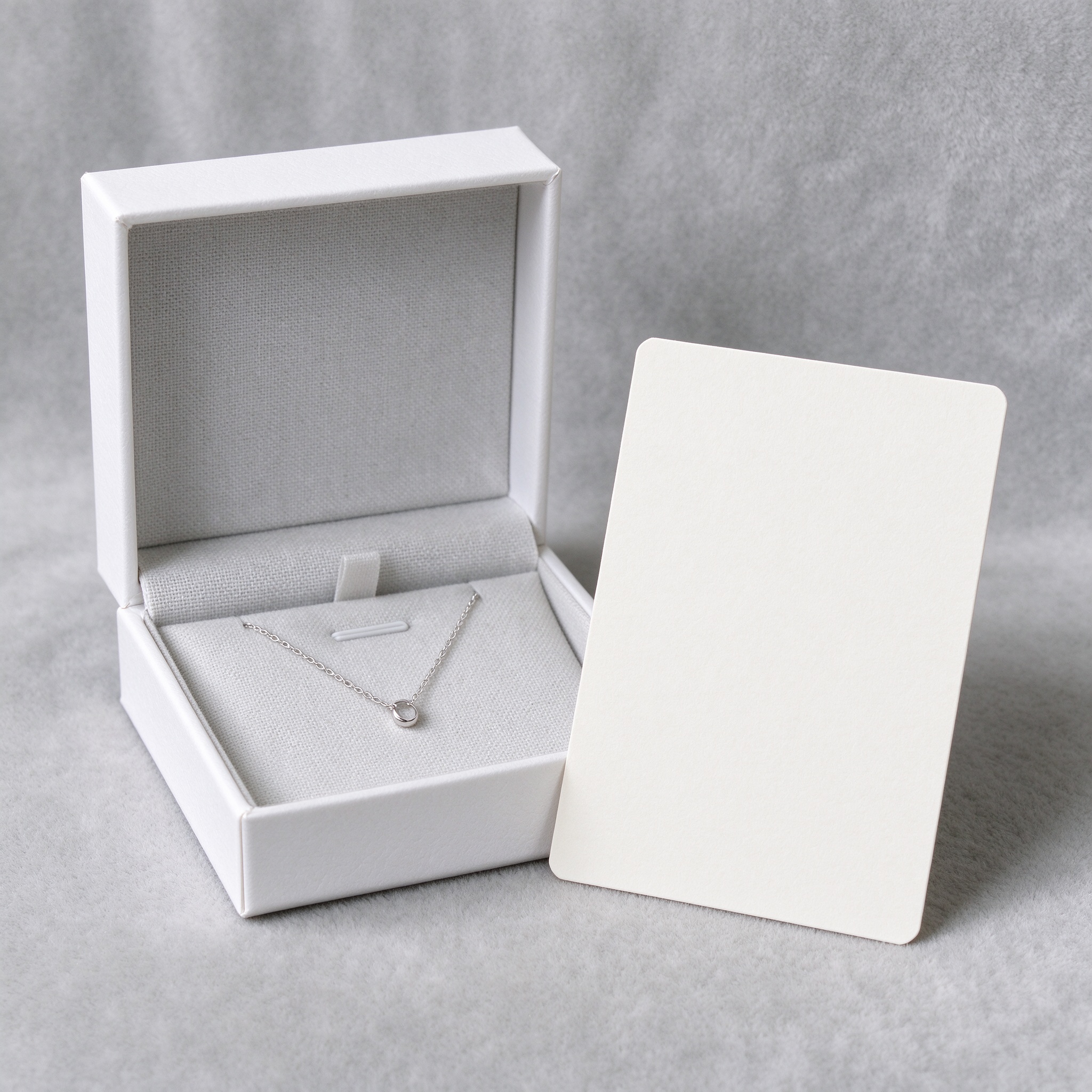
Jewelry packaging is usually three layers: the inner box that holds the piece, an outer carton or sleeve carrying the brand look, and an insert of velvet, EVA or folded card that locates and protects. The inner box carries perceived quality, the outer carries recognition, the insert decides whether the piece rattles in transit. The common combination is a rigid inner box with a paper sleeve at moderate cost; gift lines use magnetic flap boxes with ribbon. For wholesale, insert fit matters most: an oversized box is worse than a tight one, because the piece slides and most surface scratches come from exactly that.
A standard label card typically includes product name and material (925 silver, rhodium plated), country of origin, care guidance, barcode or SKU, and the responsible party details. Information-heavy markets such as the EU and US also expect size, weight and stone description. Two practical rules: put material and care on the front, because that is what buyers check at the point of decision, and leave enough quiet zone around the barcode. A skewed or low-precision barcode fails at the warehouse and stops the flow. Always print one physical label and scan it with a real scanner before a bulk run.
Beyond material and origin, common requirements include the name and address of the responsible operator inside the EU, the material stamp such as 925, and a statement or test report covering nickel release. Childrenswear and childrens jewelry attract questions about safety testing and age labelling. These are compliance fields, not design choices: a missing or misplaced item can trigger a platform correction request or a full delist. The safe method is to list every field and confirm who supplies it, whether the factory prints it on the label or the buyer applies a local sticker.
Options are mature enough now: FSC-certified cartons, recycled pulp inserts, water-based inks, dropping plastic blisters and PET windows, and paper cards instead of plastic clips. Cost usually rises 10 to 30 percent depending on volume. Note that recyclable is not the same as biodegradable, and mixed materials such as a paper box with a plastic film are harder to recycle; many European buyers now ask whether the pack is mono-material. The overlooked lever is weight: thinner packaging cuts dimensional weight, and on air freight billed by volume that saving often exceeds the material premium.
Packaging MOQs usually sit far above product MOQs: custom printed boxes commonly start at 3,000 to 5,000 units, while stock boxes can be bought by the hundred. Before going custom, total up tooling, sampling and plate costs, which dominate at small volumes. Two transit tests are worth running: a drop test from 80 cm onto all six faces to check the insert still holds the piece, and a humidity test of 48 hours at high temperature and humidity to see whether the carton deforms or the velvet turns damp. Silver fears moisture most; packaging that does not block it undoes every care instruction you ship with it.
Velvet looks better and holds the piece more firmly at higher cost; card inserts suit volume but let pieces slide. For long cross-border transit, a fitted insert reduces scratches.
Essential for retail channels, optional for pure wholesale. Leave a quiet zone and scan-test the printed label; skew or low print precision fails at the warehouse.
Custom printed boxes commonly start at 3,000 to 5,000; stock boxes can be bought by the hundred. For small runs, use stock boxes with a label until volume stabilises.
Typically 10 to 30 percent depending on volume and material. If thinner packaging also cuts dimensional weight, the freight saving often offsets most of the difference.


