

 EN

 CN
 ES

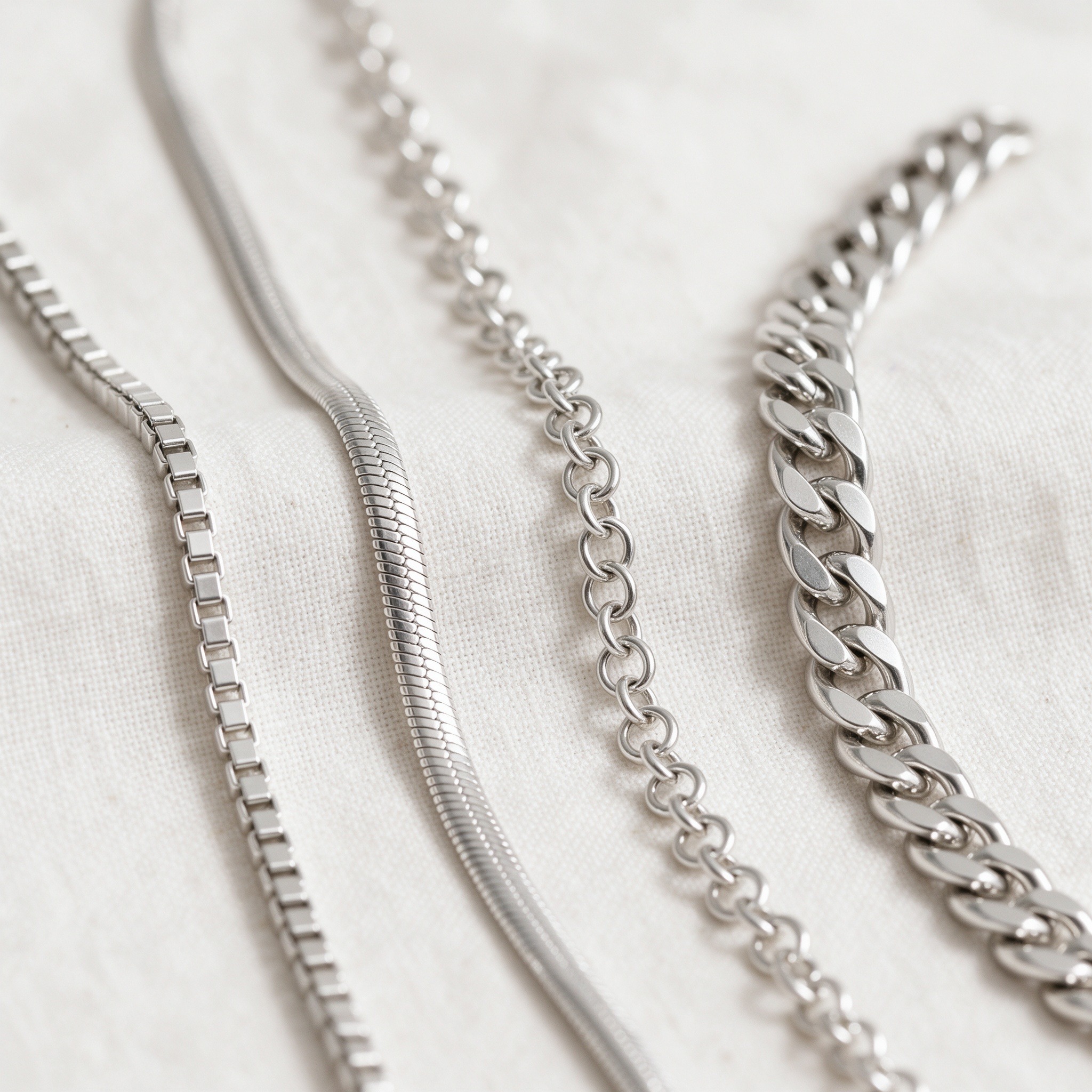
A box chain links square-section rings end to end, hollow or solid, held by solder joints. A snake chain presses several flat wires into a continuous tube with almost no visible joints, which is why it feels smooth. A cable chain is the classic round-link pattern with rings crossing at right angles. A curb chain cuts flat links at an angle and presses them tight so the result reads as one continuous band.
Construction drives everything downstream. Same metal, same 40 cm, and the four types use different amounts of silver, take different soldering hours and repair differently, so quotes differ.
Hollow box chain is the most crush-prone: sideways pressure dents the square links and they never recover. Snake chain fears bending most: one sharp fold misaligns the internal wires and the piece is effectively scrap, with almost no repair path. Cable chain is the toughest, since each round link takes load evenly and a broken link can be replaced. Solid curb chain has the highest tensile strength, paid for in weight and silver content.
For a piece worn daily with a pendant, favour cable or solid curb. If the selling point is a light, close-fitting look, snake is fine, but the product page must state that it cannot be folded or pulled.
Snake chain lies flat and smooth against skin, ideal for small pendants and letter tags, reading as a single fine line. Box chain is crisper with visible edges, good for geometric pendants and cleaner styling. Cable chain catches small highlights as it moves and is the most versatile. Curb chain has weight and sits close to the collarbone, common in mens and unisex pieces.
Drape also depends on length and pendant weight. A fine chain with a heavy pendant tips forward, so test-hang it at sampling rather than discovering it in production.
Hollow stock saves silver but adds welding and shaping labour, and dented pieces raise the reject rate. Solid stock uses more silver with steadier labour. Snake chain needs dedicated drawing equipment, so small runs rarely pay off. Curb chain cuts and presses every link, the longest route. Polishing differs too: a continuous snake surface is hard to spot-repair, while cable links can be polished one by one.
At equal weight, quotes usually rank from low to high as hollow box, cable, solid box, curb, before wire diameter and length are considered.
One, chain type and construction, with hollow or solid stated explicitly. Two, wire diameter in millimetres, commonly 0.8 to 1.2 for fine chains. Three, length and extension configuration. Four, tensile requirement in kilograms or newtons with the test method named. Five, matching clasp and plating. Add a sampling ratio and there is very little room for argument after mass production.
If a customer sends only a reference photo, compare against a physical sample of known construction instead of guessing from the image. Box and curb chains are easily confused in pictures.
Almost never. The flat wires are nested, so a bend misaligns the core and there are no individual links to replace. Replacement means a new chain, which is why the sales note must warn against folding.
Keep it under about three grams and use a small, flat pendant. Hollow squares dent under sideways load and heavy pendants fatigue the solder joints. Above three grams, move to solid or cable.
It has the longest process: angled cutting, pressing and edge trimming, plus more silver by weight. If budget is tight, a flat cable chain gives a similar look for less.
Cable and box cover most designs, snake in one or two lengths for the premium line, and curb in small quantities for mens or unisex pieces. Stocking all four ties up inventory, and snake is hard to replenish.


