

 EN

 CN
 ES

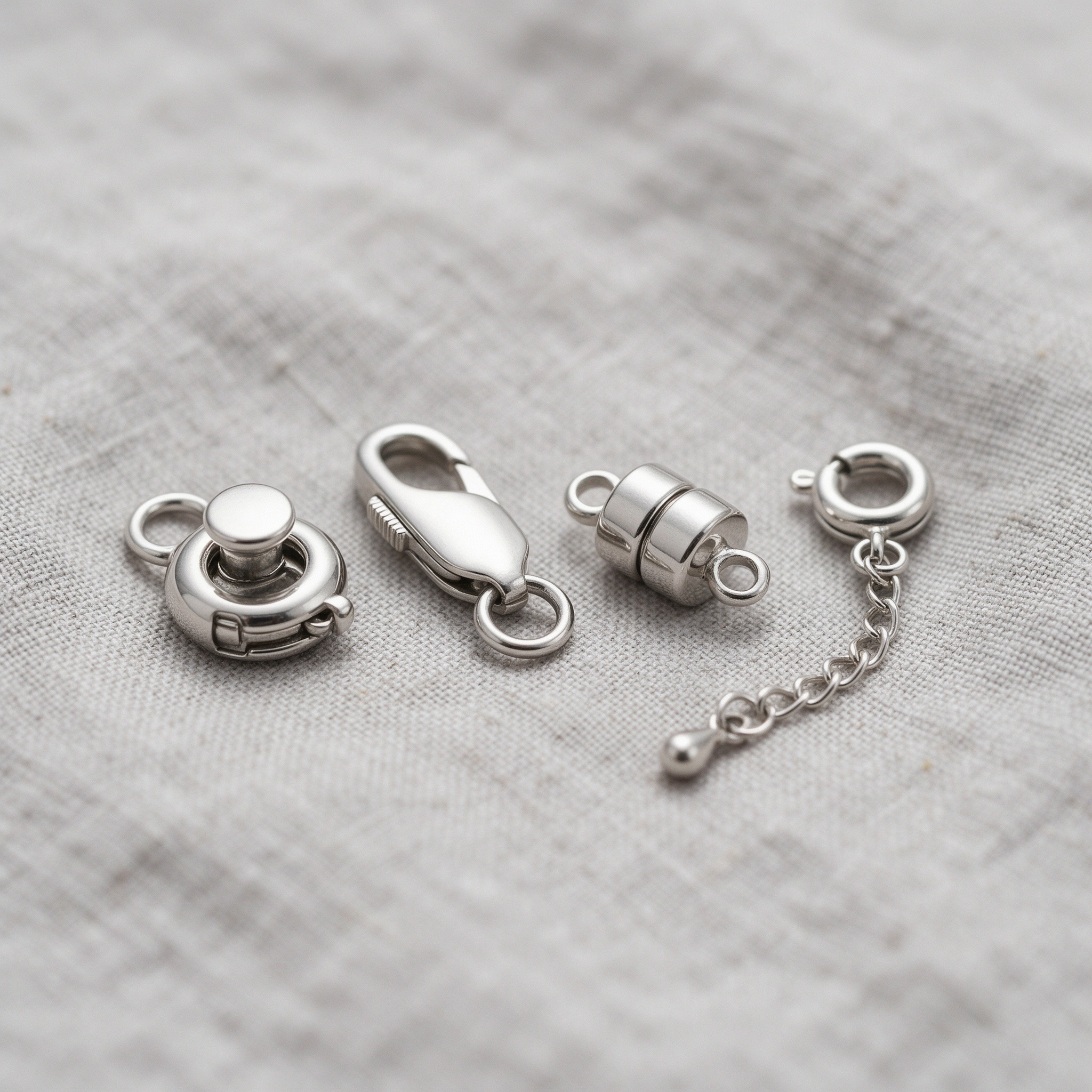
A spring clasp uses a barrel body with an internal spring and a pull ring that must be opened to attach. A lobster clasp relies on a tongue and lever: press to open, release to snap shut. A magnetic clasp pairs two magnets, better versions adding a mechanical safety. An adjustable clasp is a lobster or spring clasp plus an extension chain ending in a small bead for length fine-tuning.
Complexity maps directly onto assembly hours and failure probability. Spring clasps have the fewest parts, magnets next, lobster and adjustable the most, with adjustable adding a sliding point.
Spring clasps most often fail through tongue fatigue or grit: pulled daily, the return weakens within months until it no longer holds, and sand from a beach or pool jams the barrel. Lobster clasps open wide and take load well, but snag knitwear and hair, and the tongue loses tension once forced apart. Magnet strength decays with impacts and time, and when it releases the chain simply drops, so avoid them for children and high-value pieces. Adjustable clasps add an extension and slide bead, meaning more moving points, but they cover several wrist sizes and cut sizing returns noticeably.
Unit cost usually ranks spring, magnetic, lobster, adjustable. Spring clasps assemble easily and can be automated; magnets and safety parts carry material cost; lobster needs multiple bending and heat steps; adjustable adds extension chain, bead and extra soldering. The gap widens on small runs where tooling amortisation is high.
Watch one trap: low quotes often swap in a thinner barrel that looks identical but halves the pull strength. Require the wall thickness in writing.
Fine chains look and work best with spring clasps; heavy chains need lobster or the body will not hold. Bracelets and anklets suit lobster or adjustable. Magnetic clasps help people who struggle to fasten jewellery but must include a safety. For e-commerce, adjustable is the safer default: one extension covers two or three wrist sizes and returns drop. Never put a magnet on a mens heavy chain, it opens with any brisk movement.
Write down clasp type and material, barrel wall thickness, opening size, rated pull in kilograms or newtons, open-close cycles, plating type and thickness, and salt spray or artificial sweat requirements. Name the test method too: static or dynamic pull, cycles per minute for the life test. Add an appearance rule that the opening must align when closed and the tongue must not protrude.
On incoming inspection, open and close each sample twenty times. A batch that feels gritty or slow to snap is a reject, and it is far cheaper than handling complaints later.
The tongue fatigues under repeated pulling, losing return force, and grit or lint jams the barrel. It has the fewest parts and the lowest cost of the four, and usually the shortest life.
Yes. Magnet strength decays with impacts and time, and lateral force can separate the halves. Mechanical safety helps, but childrens and high-value pieces should still avoid magnets.
Lobster or adjustable. An adjustable clasp with an extension covers two or three wrist sizes and is the single most effective way to cut sizing returns; plain lobster relies on the buyer measuring correctly.
Use a force gauge to pull statically to the rated load and hold, checking body deformation and whether the opening separates, then add an open-close life test. Both must pass; appearance alone proves nothing.


