

 EN

 CN
 ES

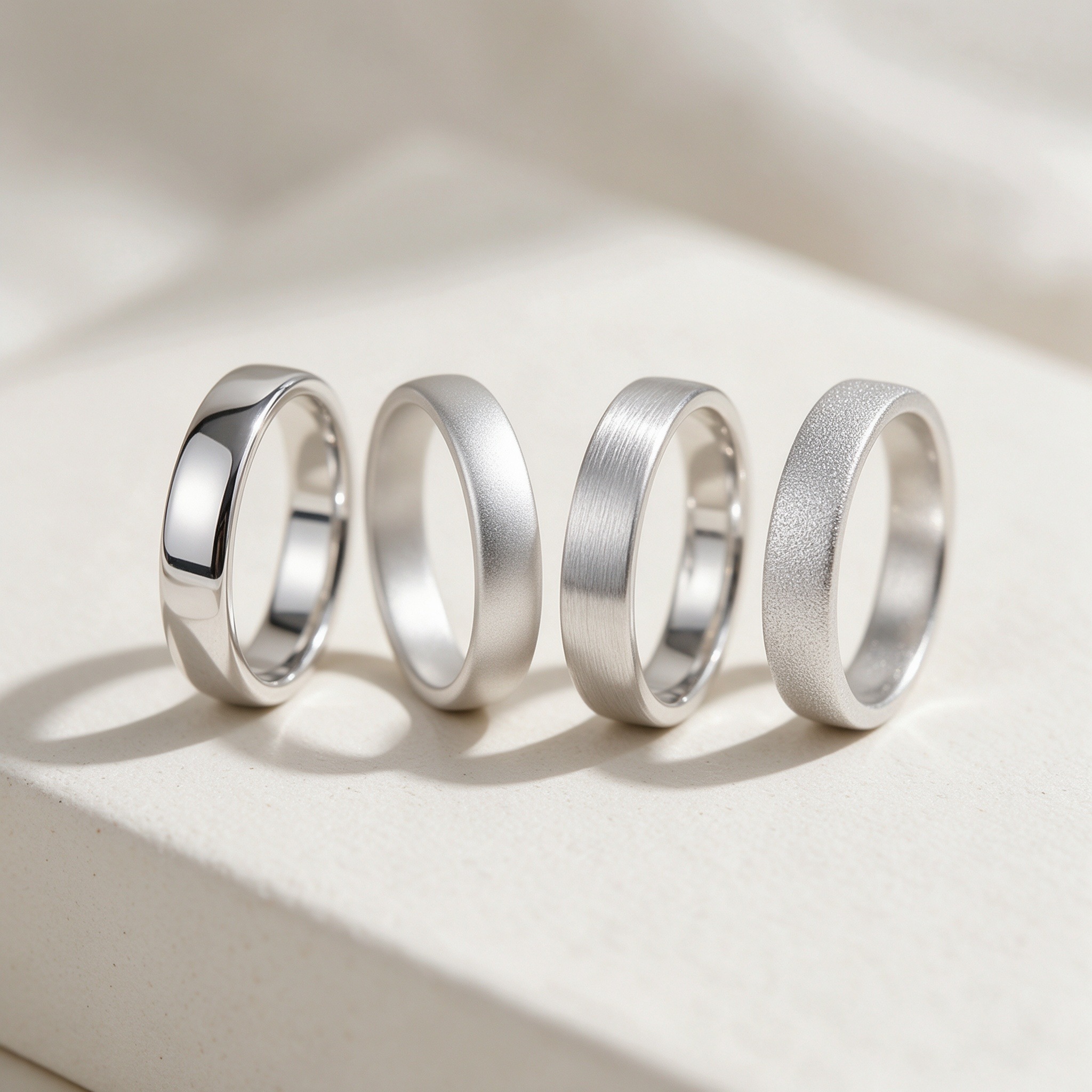
High polish takes the surface close to a mirror, with strong reflection and the whitest colour. Matte uses fine abrasive or chemical treatment for even diffuse reflection, softer and slightly grey. Brushed applies directional abrasion, leaving parallel lines that form a moving band of light. Sandblast drives fine grit at speed for a uniform frosted grain. Rhodium plating deposits a layer of rhodium over silver for a cooler white and better tarnish resistance.
The first four mechanically or chemically reshape the silver itself; the fifth adds another metal. That difference sets wear behaviour, repair options and how each is priced.
High polish is the brightest and looks cleanest, suited to plain bands, smooth pendants and minimal designs. Matte is understated with a fine grain, good for antique bases and vintage looks. Brushed is directional, the highlight moving as the piece turns, which reads as crafted. Sandblast has a coarser grain close to frosted glass, useful for texture contrast. Rhodium sits between polish and matte, cooler in tone, and is the practical choice when several batches must match.
In one lot, high polish exposes colour variation worst because a mirror amplifies differences in lighting; sandblast and matte hide them better, which is why suppliers often recommend matte.
High polish fears wiping: tissue and clothing fibres leave fine scratches, and once scratched the piece needs full re-polishing because local repair is impossible. Brushed scratches hide along the grain and stay acceptable. Sandblast wears into bright patches, more visible than a scratch. Matte wears best, brightening slightly and evenly. Rhodium, once worn through, reveals silver and must be re-plated.
So polished pieces suit display and occasional wear, while daily pieces are better in matte, brushed or sandblast. For a bestseller, this matters more to repeat purchase than the design itself.
Rhodium gives consistent colour and strong tarnish resistance, valuable when three storefronts or several batches must match. Cost scales with thickness and plated area, usually a per-piece premium. Thin plating wears through at edges and inner bands first; thick plating costs more and can flake if brittle. Decorative work commonly runs 0.05 to 0.1 micron, wear resistance above 0.1.
Promising it will never wear is unrealistic. Write down thickness, test standard and expected life under normal wear, and note that re-plating is possible after wear-through.
Replace subjective judgement with checkable items: surface roughness Ra range, consistency of brush direction, sandblast uniformity with no bright patches within a piece, colour compared under a standard light source with a stated tolerance, scratches graded by length and count, and plating thickness spot-checked by XRF. Add sampling and a decision rule, for example five pieces per lot and rejection of the lot when two or more fail.
Always keep a sealed golden sample at sampling stage, labelled with finish and batch. Every later dispute is settled against it, which is the least painful arrangement.
Matte reflects diffusely and looks soft from every angle; brushed has a clear direction and shows a moving highlight band as it turns. Side light makes it obvious, and a loupe reveals parallel lines.
Daily wear always leaves fine scratches to some degree. Polish suits display and occasional wear; for everyday pieces, matte, brushed or sandblast cut repair rates substantially.
It depends on thickness and wear. Decorative plating around 0.05 micron lasts months in daily use; above 0.1 micron with good preparation lasts longer. Worn-through pieces can be re-plated rather than scrapped.
Compare under standard light first, then decide whether it is process inconsistency or plating thickness difference. Exceeding the agreed reject ratio means returning the lot; minor variation inside the golden sample range can be settled by a discount.


