

 EN

 CN
 ES

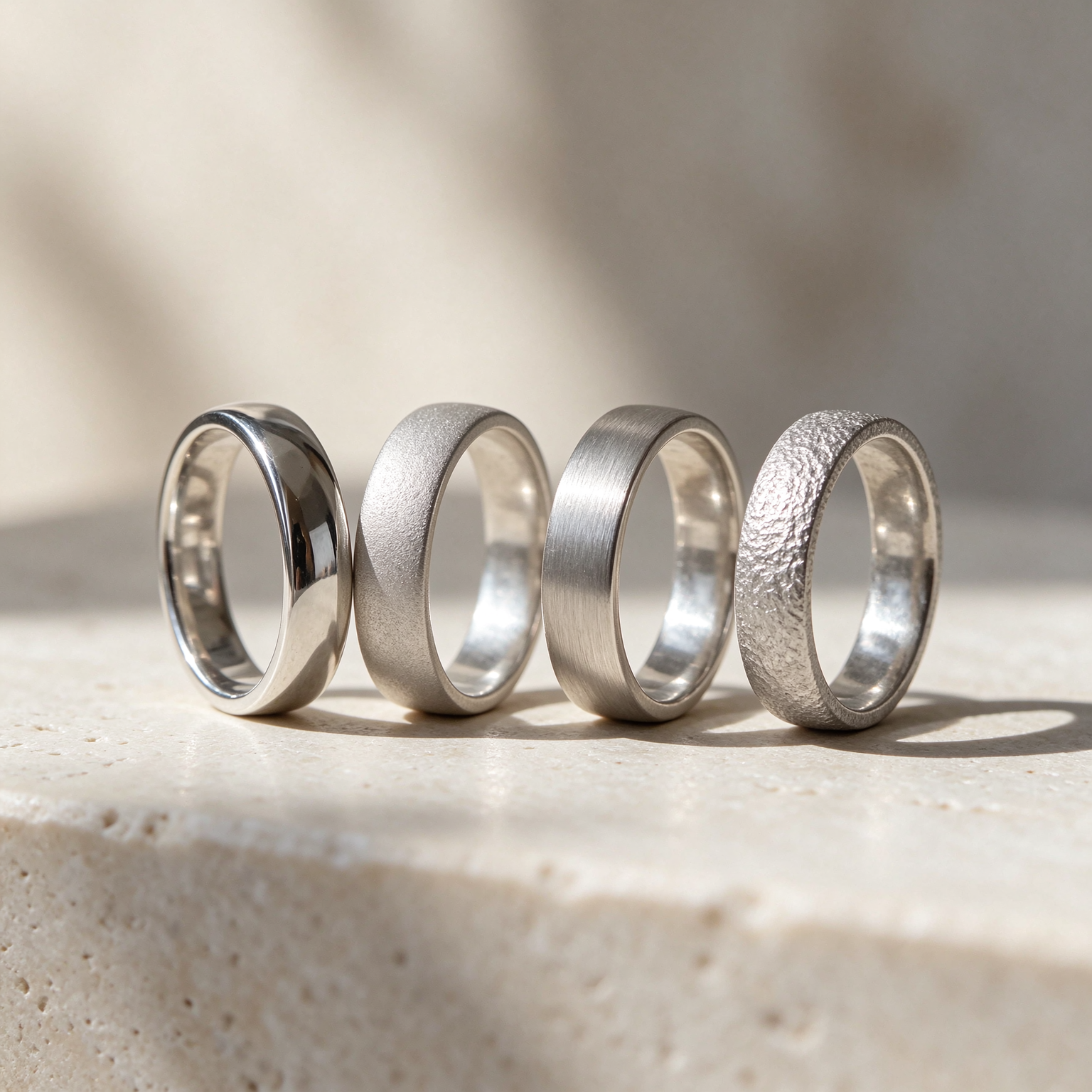
Brushing draws fine parallel lines across the metal for a matte, directional look; sandblasting fires fine grit to form an even, soft non-reflective haze; polishing buffs the surface to a warm shine; mirror polish uses fine grit for a high-reflection mirror-like face. The four can stand alone or combine locally on one piece, such as a mirror face with a brushed band.
Mirror is brightest but shows fingerprints and fine scratches most clearly, with wear marks obvious over time; brushing hides light scratches and stays neat when lines are uniform; sandblasting is a soft haze that can brighten locally as grit wears; polishing sits between, even but less sharp than mirror. On the same silver, a brighter face shows fine scratches more, while matte surfaces tolerate daily wear better.
Plain bands and business pieces suit brushing or sandblasting for a quiet look; wedding, memorial and gift pieces often use mirror polish for metal shine; vintage and handmade styles can pair brushing with antiquing. Rings and bracelets that rub favour matte brushing or blasting; studs and pendants rub less and can take mirror for quality. A set should share one finish to avoid a bright-versus-matte clash.
Surface treatment happens after forming, before or around plating: shape and grind, then brush or blast, then rhodium or gold plating as the style needs. Plating changes reflection and colour; rhodium is cool and bright, rose gold warm. A thick layer over matte fills the grit, so clear brushing needs controlled plating thickness. An intact coating slows tarnish and keeps the finish longer.
One, finish type, brushed, blasted, polished or mirror, and line direction; two, matte or bright, with local combinations marked; three, plating type and thickness; four, surface defect standard for scratches, pits and fingerprints; five, sample comparison and bulk sampling standard. Check evenness and reflection in natural light on samples, then bulk-check line direction and shine against the sealed piece.
Brushing leaves parallel fine lines with a strong direction; blasting gives an even gritty haze with no clear direction. Brushing reads as line texture, blasting as overall matte, chosen by style.
Mirror reflects most strongly, so fingerprints and fine scratches show best and wear marks become obvious. Rub-prone rings and bracelets suit matte; studs and pendants can use mirror.
Yes. Wear brightens patches or blurs lines, and tarnish or plating wear changes shine. An intact coating and less friction slow ageing; matte wears better than mirror.
State finish type, line direction, plating thickness and defect allowance; compare evenness and reflection in natural light, then bulk-sample lines and shine against the sealed piece.


